
Suppose your addition needs 8 million Btu of cooling over a summer. That figure describes heat removed from the room. The utility sells electricity in kilowatt-hours. SEER2 connects the two because its units are Btu of seasonal cooling per watt-hour of electricity. You need one more number from your bill, the price of the next kilowatt-hour.
From the cooling load to dollars
Cooling kWh = seasonal cooling delivered in Btu ÷ SEER2 ÷ 1,000. The last division converts watt-hours to kilowatt-hours. Multiply the result by your electricity price in dollars per kWh. If your load estimate is already in millions of Btu, the shorter expression is cooling kWh = millions of Btu × 1,000 ÷ SEER2.
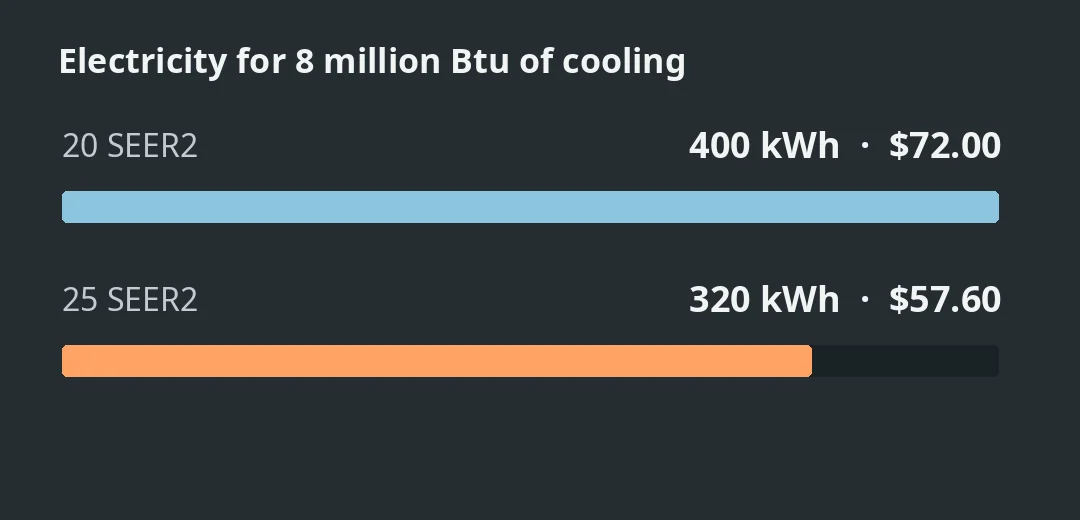
At 20 SEER2, that addition uses an estimated 8 × 1,000 ÷ 20 = 400 kWh for summer cooling. At an illustrative $0.18/kWh, that comes to $72. A 25 SEER2 pair serving the same addition uses 320 kWh, or $57.60. The summer difference is $14.40. Over ten identical summers, the cooling-only difference is $144 before any changes to utility rates or usage.
Find the two numbers that belong to your house
Ask whoever modeled the addition for its estimated annual cooling load, in Btu per year. A design report might instead say “12,000 Btu/h.” That's a rate of heat removal during a design condition. Multiplying it by every hour the system is on assumes it runs at full output each hour. A variable-speed unit can spend much of that time delivering less.
On the utility bill, include per-kWh supply and delivery charges that change with usage. Leave out a fixed monthly customer charge you would pay either way. With time-of-use pricing, try the off-peak and peak rates separately to see the range. A closer estimate accounts for how much electricity the unit uses during each price period.
To reproduce the example in the catalog, open Electricity assumptions, enter 8 for annual cooling, 0 for annual heating, and 0.18 for the rate. Choose two pairs that meet the room load. The ten-year ranking includes the listed equipment price, while the electricity subtotal shows the operating part by itself.