
Walk outside after the traffic dies down. From your open bedroom window, find the spot where the installer wants to put the heat pump. Then look across the fence. On some lots the neighbor’s bedroom sits closer to the unit than any room in your own house. A spec sheet can help you compare machines. That walk tells you whose window to consider.
Find the outdoor row on the spec sheet
Start with the outdoor model number. The low fan-speed rating for a wall-mounted indoor head describes a different machine. Next, look for the words “sound pressure” or “sound power.” Both can carry the label dB(A). Sound power describes the sound emitted by the equipment under the stated test conditions. Sound pressure describes what a microphone measures at a position. The distance, direction and nearby reflecting surfaces matter. ASHRAE explains how the two measurements relate.
The Mitsubishi Electric PUZ-A24NHA7 submittal gives an example of what to read. Its outdoor sound-pressure row shows 47 dB(A) in cooling and 48 dB(A) in heating. Those are figures for that model under its rating conditions. They cannot tell you the level at your pillow. When comparing two bids, ask for the same measurement and operating mode, and the microphone distance for any pressure figure.
Listen from the receiving end
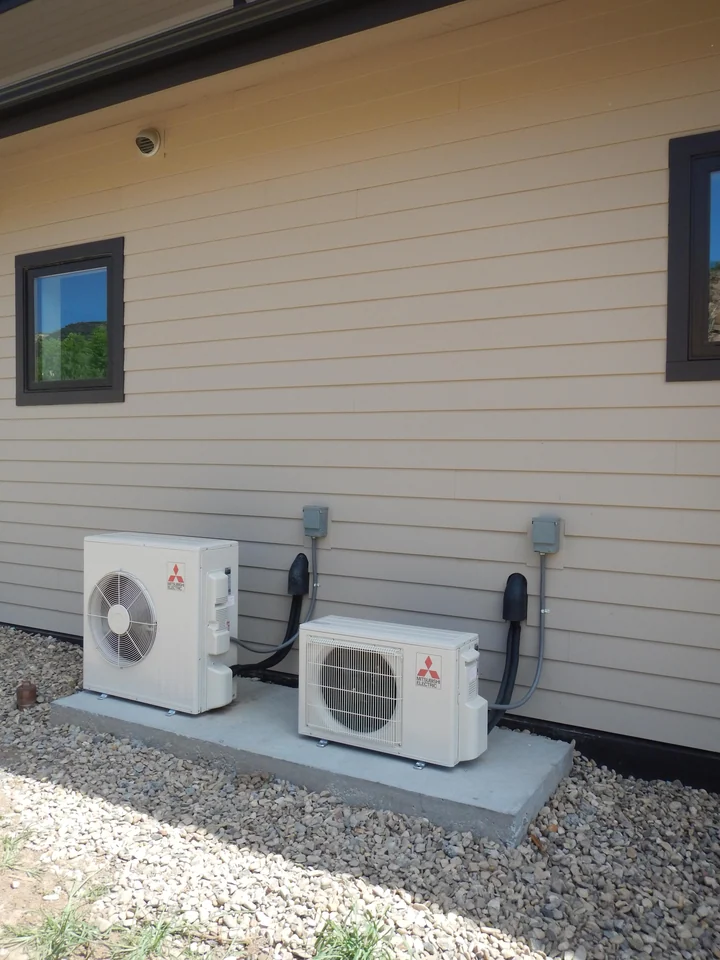
A narrow passage with hard siding on one side and a solid wall on the other deserves a closer look. Reflections can change what someone hears there. A wall bracket can also carry vibration into the building. Ask the installer to compare that location with an outdoor-unit location facing open space, or a ground-supported stand where feasible. If there’s a similar installation nearby you can listen to with permission, find out whether the system is idling, heating or cooling when you visit.
Keep the windows you open in summer and the rooms you sleep in during winter on the same sketch. Ask whether a quiet setting changes the equipment’s available output, and what setting the installer assumed. Relying on a setting nobody intends to use at night defeats the point of the comparison.
Ask where the local rule is measured
Check with your local building or noise office about the applicable hours, measurement point and method. A published rating at the machine and a local limit at a property line are different quantities. If the site is close or the result matters for a permit, have the contractor document how the proposed location will meet the local requirement.
| Label on the sheet | Question to take to the installer |
|---|---|
| Outdoor sound power | Which operating mode and test condition? |
| Outdoor sound pressure | At what distance and in which direction? |
| Indoor quiet fan | Where is the separate outdoor rating? |
| Local noise limit | What location, hours and method apply here? |