
A new wall head warms the family room, but the old baseboard heater still has its own thermostat on the opposite wall. Both can call for heat. Which one should run on an ordinary winter evening? An answer starts with how much heat that room loses as the outdoor temperature falls, how much the mini-split can supply, and whether those two controls know about each other.
Find the point where the room needs help
Ask your designer to plot the heating load for the space served and the selected mini-split’s cold-weather output at several outdoor temperatures. Where the lines cross is the thermal balance point. Below it, a shortfall appears if heat loss exceeds available output. If the mini-split serves an addition and the boiler serves the whole house, use the addition’s load for this comparison. The boiler still has other rooms to heat. PNNL’s guide to sizing cold-climate heat pumps illustrates the two curves.
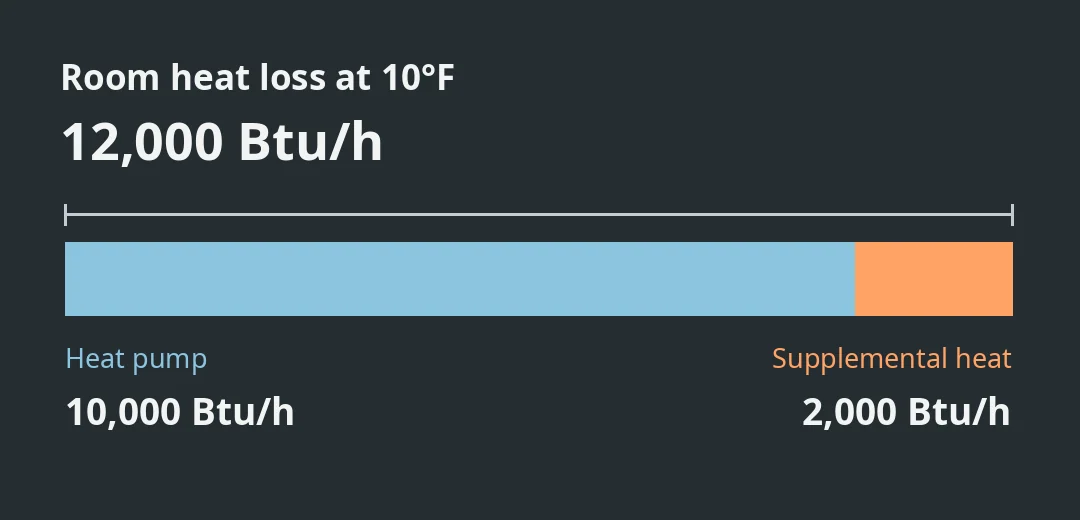
Consider an example at 10°F. The family room loses 12,000 Btu/h and the mini-split can supply 10,000 Btu/h. Together the sources can hold the target temperature if a backup delivers the remaining 2,000 Btu/h to that room. If the control shuts the mini-split off completely, the other source must supply the full 12,000 Btu/h. Give both numbers to the installer before discussing the setting.
Agree on the sequence at the thermostats
Have the designer write down which unit starts first, whether the equipment and controls support simultaneous operation, and what brings the second source on. With separate thermostats, ask for a demonstration in the rooms they actually sense. A hall thermostat may be satisfied while a bedroom behind a closed door still needs heat. At handoff, record the normal settings and whom to call if one room stays cold or both systems run on mild days.
A homeowner keeping a fuel-fired furnace might also want to switch sources when fuel becomes less expensive per unit of delivered heat. That economic switchover depends on the fuel and electricity rates, furnace efficiency and heat pump performance at the outdoor temperature in question. Mass Save’s switchover calculator is an example for its service area. Bring your own utility prices to the conversation. Have the contractor confirm that the chosen source can carry the load through the proposed changeover.