
A wall-mounted head in cooling mode removes moisture from the room. Water collects in a shallow pan and needs a route out of the house or to another approved drain. Before you agree to a location over a piano, bookshelf or finished floor, ask the installer to point to both ends of that route.
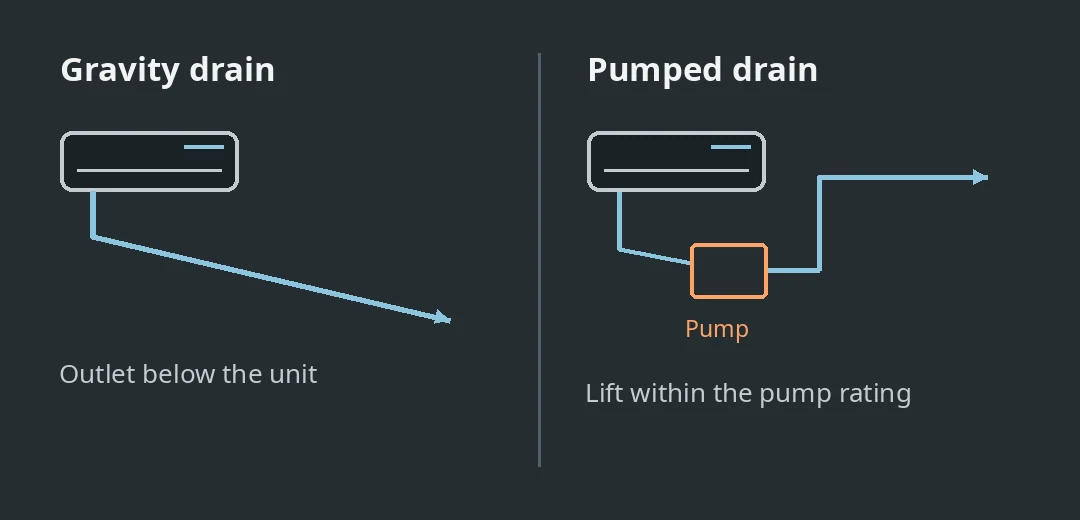
Draw the route in profile
A floor plan shows where a hose runs. A side view shows whether water can get there by gravity. An exterior wall may give the installer a short, falling path to an acceptable outlet. An interior wall can work too, if there is a route that keeps falling. A single climb over a beam changes the answer even when the final outlet is far below the head. The GREE Livo GEN3 instructions illustrate a wall unit that relies on a continuous downward run. The installer should use the drawings and slope requirements for the unit actually being fitted.
Stand at the proposed outlet. Where will the water go on a humid afternoon? Consider the foundation, an entryway and any downstairs neighbor. For a connection inside the house, ask which disposal point is permitted locally and how someone will reach it to inspect or clean it. An attractive line cover on the outside tells you little about the route behind it.
When the water has to go up
A condensate pump collects the water and lifts it past an obstacle. That can make an interior wall practical. It also puts a powered part somewhere in or near the room. Ask for the pump model, where it will sit, what you may hear when it runs and what happens if the level rises too far. Have the contractor explain which overflow protection the quoted installation includes. Pump designs vary. RectorSeal’s Ghost external pump, for example, sits below the indoor head and has a reservoir accessible from the front.
If two walls would both serve the room well, get separate installed prices for the gravity route and the pumped route. Include access for later service in the comparison. A pump hidden behind permanent trim may become expensive to reach.
Watch the drain test
At handover, ask the installer to demonstrate that test water reaches the agreed outlet and to show you where a future leak would first be visible. Photograph the outlet and mark any concealed pump on your records. If water starts to run down the indoor wall during use, stop cooling and contact the installer. Note which head was running and where the first drop appeared.
| Route on the sketch | What to settle before signing |
|---|---|
| Down and out through an exterior wall | Confirm continuous fall and a suitable outlet. |
| Past a beam and up into a ceiling | Ask about a pump or another wall. |
| Concealed pump in the proposed route | Locate its service access and overflow protection. |
| Either route | Ask to see test water reach the outlet. |