
At 7 a.m. the bedroom thermometer reads 73°F, the humidity meter reads 66%, and the sheets feel damp. Lowering the setpoint may make the room colder before it feels drier. Write down both readings and the time. Compare them with an afternoon reading from the same spot, away from a supply jet or a sunny window. One reading after a shower and a daily pattern throughout the house call for different follow-up questions.
One coil has two jobs
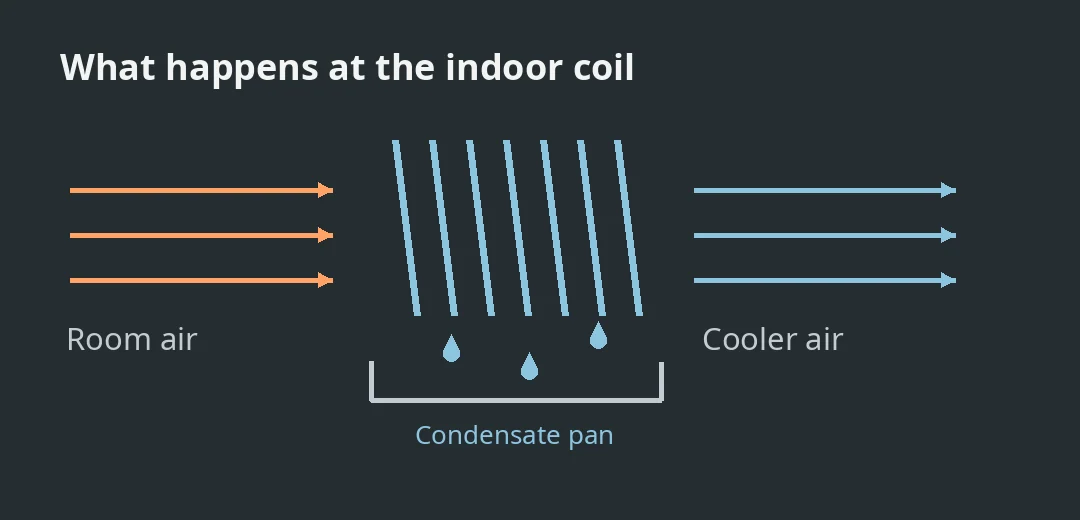
Sensible cooling lowers the air temperature. Latent cooling removes water vapor as moisture condenses on a cold coil and drains away. A unit’s total cooling capacity includes both. If a sheet lists 10,000 Btu/h of total cooling and 7,500 Btu/h of sensible cooling, the remaining 2,500 Btu/h is latent cooling at that specific test condition. Change the entering air temperature, moisture level or airflow and the split can change. Those example figures are rates of heat removal. To estimate how many pints will collect tonight, you would also need the actual operating conditions and run time.
An oversized unit can satisfy the temperature setting in short runs. That leaves less time with a cold coil collecting and draining moisture. An inverter can reduce cooling output, although it also has a minimum cooling output. A rainy evening with little need for sensible cooling can reveal a humidity problem even if the unit holds the room temperature perfectly on a hot afternoon. PNNL explains the connection between cooling load and supplemental dehumidification.
What does the Dry button actually control?
On Daikin’s Atmosphera FTXM-W wall heads, Dry controls the fan automatically. Page 14 of the Atmosphera operation manual shows that you can leave the temperature target at the room temperature when Dry starts or lower it by up to 5°F in 1°F steps. The remote offers no humidity percentage setting in this mode. If your goal is to hold a particular relative humidity on a cool, wet day, ask the installer to show you how the proposed model would do that.
For a persistently damp bedroom, ask the installer to check for moisture sources, bathroom exhaust, outdoor air entering the space and condensate drainage. Then ask what sensible and latent loads were calculated, and how the proposed pair handles those loads at your summer design conditions. ACCA Manual S covers equipment selection for both cooling and dehumidification. If moisture remains high when there is little demand for cooling, request a separate price for dedicated dehumidification and a plan for its drain.
| Equipment figure | At one stated condition |
|---|---|
| Total cooling | 10,000 Btu/h |
| Sensible cooling | 7,500 Btu/h |
| Latent cooling by subtraction | 2,500 Btu/h |
| Share used for sensible cooling | 75% |