
One line on a spec sheet deserves a look before buying a mini-split for a small space. Find the capacity table, go to cooling, and read the row labeled “minimum.” It tells you how little heat the system can remove while its compressor keeps running at the stated conditions. The units are Btu/h. Watts on the next line describe electrical input, a different measurement.
Two 12,000 Btu/h pairs, side by side
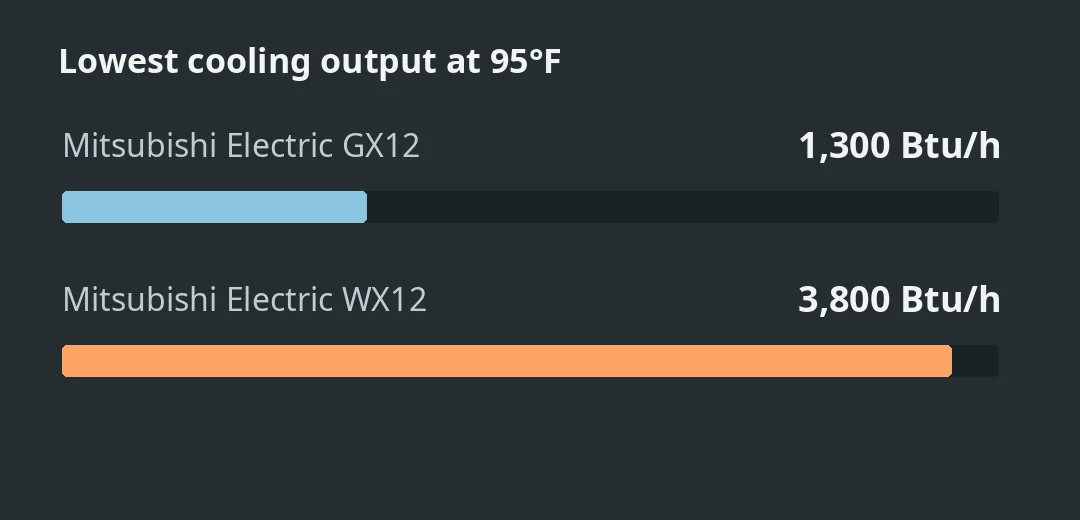
Mitsubishi Electric rates both the MSZ-GX12NL with MUZ-GX12NL and the MSZ-WX12NL with MUZ-WX12NL at 12,000 Btu/h of cooling. At 95°F outdoors, the GX12 submittal lists a minimum of 1,300 Btu/h. The WX12 submittal gives 3,800 Btu/h. The indoor test air for both is 80°F dry bulb and 67°F wet bulb. Dry bulb is ordinary air temperature. Wet bulb also reflects how much moisture is in the air.
Imagine a room gaining 2,500 Btu/h under those same conditions. That load lies inside the GX12’s published cooling range. It falls below the WX12’s minimum. To deliver 2,500 Btu/h on average, the WX12 would have to alternate periods of cooling with periods when the compressor is off. That example tells you which pair can match the load continuously on paper. Cycle length in the installed room also depends on the controls and how quickly the space warms up.
Which number applies on an October afternoon?
At 78°F outdoors, you need a different point on each unit’s performance curve. Outdoor conditions, the air coming into the indoor unit and the controls affect operation. Ask the installer for data nearer the conditions when your room needs only a little cooling. Heating has a separate capacity range. For a room that mainly needs fall and spring heat, ask about its minimum heating output at a mild outdoor temperature. NEEP explains why designers check both ends of the operating range.
For your quote, write the complete model pair beside each figure and label it heating or cooling. Ask which pair can meet the peak load, then compare their low outputs for the hours you actually use the room. A 95°F data point is useful for comparing like with like. Leave the expected shoulder-season run time open if the manufacturer hasn’t published the relevant data.