
You set the heat to 70°F. An hour later the room is comfortable and the outdoor unit is still running, only more quietly. It may be supplying heat at about the same rate the room is losing it. An inverter-driven compressor can slow down as the room approaches the set temperature. A single-speed compressor handles a small load by running for part of the time and shutting off for the rest.
What changes speed?
The compressor circulates refrigerant between the indoor and outdoor coils. In the outdoor unit, a rectifier converts incoming AC power to DC. The inverter then supplies the compressor motor with AC at a frequency the controls can vary. Changing that frequency changes motor speed, refrigerant flow and the amount of heat the system can move. Daikin’s service manual illustrates the electrical path. The Low, Medium and High buttons on the remote set the indoor fan speed. That fan moves room air across the coil. Its speed setting tells you little about how fast the outdoor compressor is turning.
How low can it go?
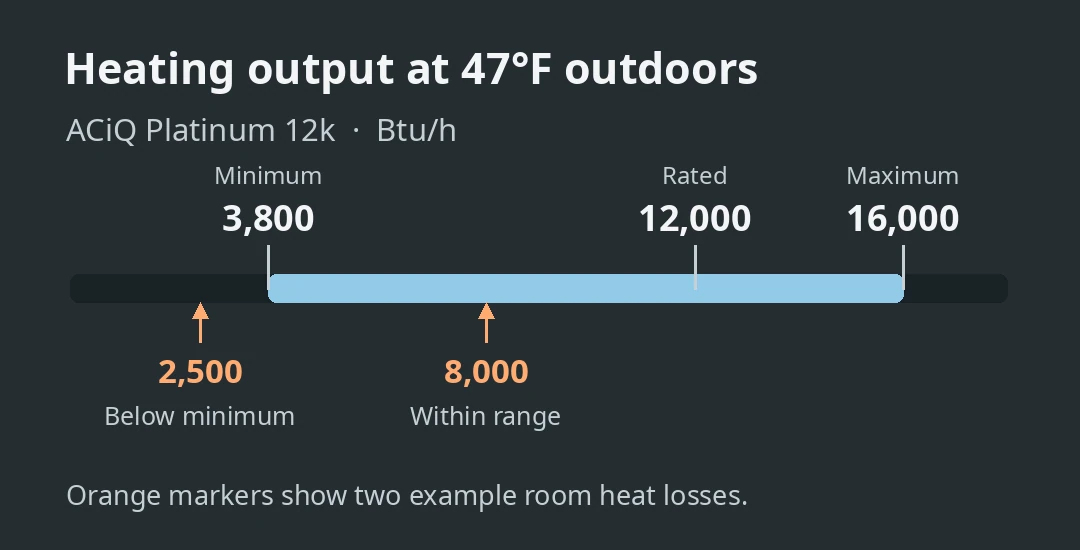
Take ACiQ’s ACIQ-12W-HH-MD and ACIQ-12ZPL-HP230C pair. At 47°F outdoors, the manufacturer’s heating table gives a rated output of 12,000 Btu/h and a range of 3,800 to 16,000 Btu/h. A room losing 8,000 Btu/h under those conditions falls inside the range. On paper the compressor has enough range to match that loss. For a room losing just 2,500 Btu/h, even its lowest continuous output is too high. The compressor will have to stop for part of the time to hold a steady temperature on average.
Those are two illustrative room loads at one outdoor temperature. A different day moves both the room load and the equipment’s operating range. PNNL’s sizing guide explains how to compare them. If cooling a bedroom is your main concern, use the minimum cooling capacity for the proposed pair.
What longer runs mean for the room and the bill
At part load, steadier heat delivery can reduce temperature swings and spare you a succession of warm blasts. Run time alone won’t price that comfort. A system averaging 500 watts for two hours uses the same 1 kWh as one averaging 1,000 watts for an hour. Those numbers illustrate the arithmetic. The heat delivered in each case depends on the equipment and conditions. The U.S. Energy Information Administration explains how utilities measure electricity.
When comparing bids, ask for the minimum and maximum output at temperatures your home actually sees. Have the installer mark the room’s estimated heat loss beside those numbers. Then compare installed prices and estimated annual kWh at your electricity rate. That gives you a way to judge whether paying more for a wider operating range will buy comfort, bill savings or both.
| Line on the quote | What it tells you |
|---|---|
| Minimum output at a stated temperature (Btu/h) | How small a steady room load the system can serve. |
| Maximum output at your design temperature (Btu/h) | Whether the proposed pair can meet the room load on a design day. |
| Estimated annual electricity use (kWh) | How much electricity to budget at your rate for the modeled heating and cooling loads. |